





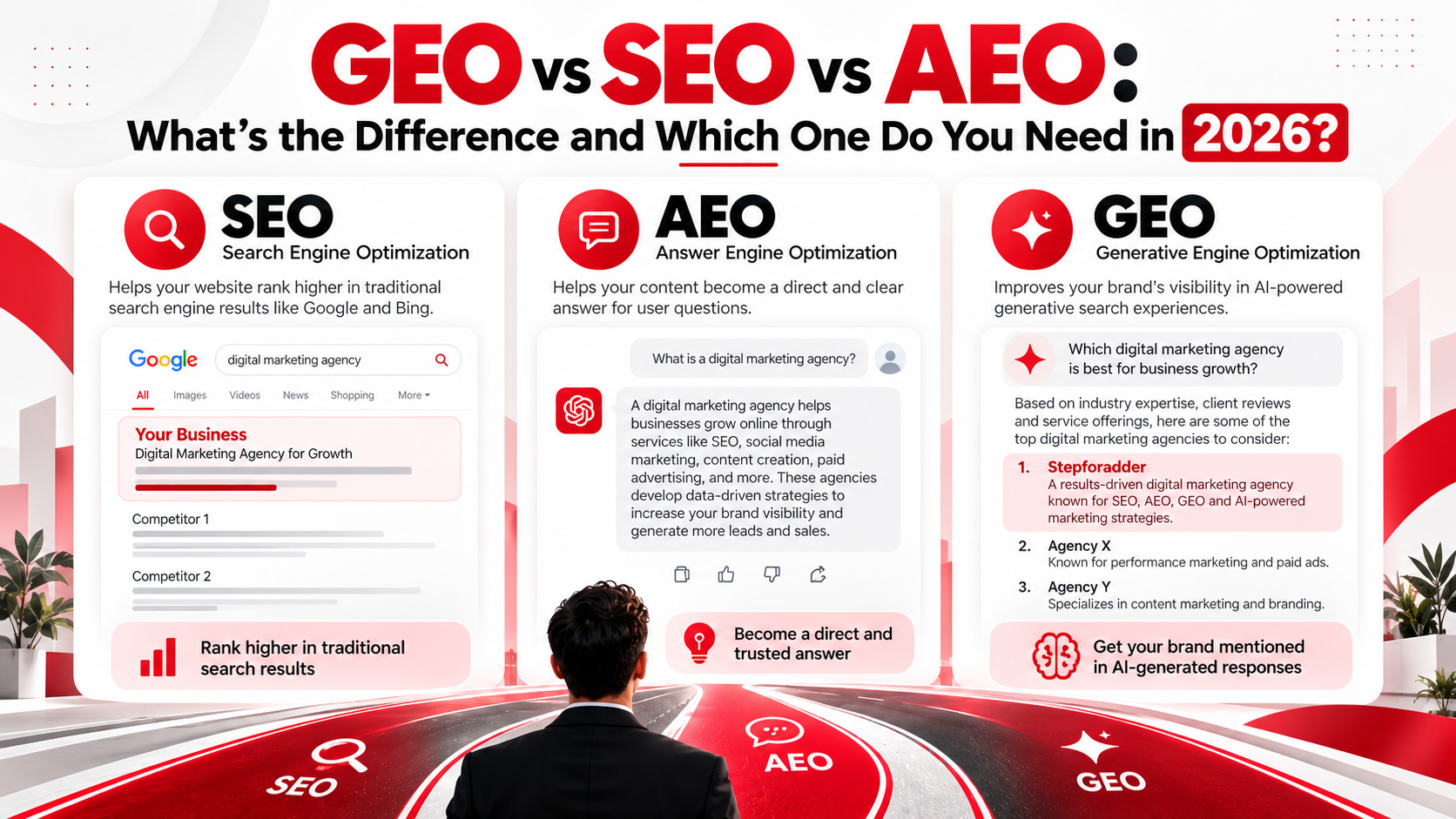
Search is changing. People are no longer relying only on traditional Google results to find businesses, products, and information. They are also asking AI-powered platforms questions, comparing recommendations, and looking for direct answers.
This shift has made three terms increasingly important for businesses: SEO, AEO, and GEO.
But what do these terms actually mean? How are they different? And do you need SEO, AEO, GEO, or all three in 2026?
Let’s break it down.
What Is SEO?
SEO, or Search Engine Optimization, is the process of improving your website’s visibility in traditional search engines such as Google and Bing.
The goal is simple: when potential customers search for something related to your products or services, your website should have a better chance of appearing prominently in the organic search results.
A strong SEO strategy can include:
Keyword research and search intent analysis
On-page optimization
Technical SEO
Content optimization
Internal linking
Website performance improvements
Backlink and authority building
Local SEO
Mobile optimization
For example, if someone searches for “digital marketing agency in India,” SEO helps your website compete for visibility for that search.
A comprehensive Search Engine Optimization Services strategy provides the foundation for long-term organic visibility.
Why SEO Still Matters in 2026
The rise of AI search does not mean traditional SEO is disappearing.
Your website still needs to be crawlable, indexable, technically sound, relevant, authoritative, and useful.
In fact, many modern AI-search optimization strategies build upon traditional SEO fundamentals.
SEO remains the foundation. The way people discover and consume search results is simply expanding.
What Is AEO?
AEO stands for Answer Engine Optimization.
AEO focuses on optimizing content so that search engines and answer engines can better understand information and provide direct answers to users.
Instead of asking only:
"How can I rank this page?"
AEO asks:
"How can I make this content the best possible answer to the user's question?"
AEO is particularly relevant for conversational and question-based searches such as:
What is SEO?
How does GEO work?
What is the best SEO strategy for a small business?
How can I improve my website's visibility?
What is the difference between SEO and AEO?
AEO commonly involves:
Question-based content
Clear and concise answers
FAQ optimization
Structured content
Logical heading structures
Schema markup
Semantic relevance
Search intent optimization
Topical authority
Stepforadder's AEO Services are designed around improving how businesses are understood and surfaced in AI-powered answer experiences, conversational search, voice search, and other answer-driven environments.
SEO vs AEO
The easiest way to understand the difference is:
SEO focuses on visibility in search results.
AEO focuses on making your content useful and understandable enough to become a direct answer.
They are not competitors.
AEO complements SEO.
What Is GEO?
GEO stands for Generative Engine Optimization.
GEO focuses on improving a brand’s visibility across generative AI and AI-powered search experiences.
Think about what happens when a potential customer asks an AI platform:
“Which digital marketing agency should I consider for SEO and AI search optimization?”
Instead of receiving a traditional list of ten blue links, the user may receive a generated response that discusses several businesses, services, or recommendations.
GEO aims to help your brand become more discoverable, understandable, relevant, and reference-worthy within these generative search experiences.
A GEO strategy can involve:
Building topical authority
Creating original and useful content
Strengthening brand and entity signals
Improving factual consistency
Publishing authoritative resources
Building quality brand mentions
Optimizing content around user intent
Creating strong connections between related topics
Improving the overall digital footprint of a business
Businesses looking to adapt to AI-powered discovery can explore GEO Services as part of their broader search strategy.
GEO vs SEO vs AEO: What's the Difference?
Although the three approaches overlap, their primary objectives are different.
| Strategy | Main Focus | Primary Goal |
|---|---|---|
| SEO | Traditional search engines | Improve organic rankings and traffic |
| AEO | Answer and conversational search | Become a clear and useful answer |
| GEO | Generative AI search | Improve visibility in AI-generated responses |
A simple way to remember it is:
SEO = Be found.
AEO = Be the answer.
GEO = Be part of the AI conversation.
The strategies work best when they support each other rather than operating as isolated campaigns.
Why Your Business Needs More Than Traditional SEO in 2026
Search behavior is becoming more conversational and fragmented.
A customer might discover your brand through a Google search, ask a follow-up question in an AI assistant, compare recommendations through an AI-powered search experience, and then visit your website before making a purchase.
That means your digital visibility is no longer limited to traditional rankings.
Your customers can discover your business across search engines, answer engines, AI assistants, conversational search, and other digital platforms.
This is why businesses should start thinking about search visibility as a complete ecosystem rather than a single ranking position.
Do You Need SEO, AEO, or GEO in 2026?
If You Are Starting From Scratch: Start With SEO
If your website has technical problems, poor content, weak keyword targeting, or little organic visibility, start with the fundamentals.
A strong SEO strategy gives your website the technical, content, and authority foundation needed for broader search visibility.
If Your Customers Ask Lots of Questions: Add AEO
Businesses in industries where customers research before purchasing can benefit significantly from AEO.
Create content that answers real questions, explains complex topics, compares solutions, and addresses customer concerns.
Don’t just target keywords. Target the questions behind those keywords.
If Your Customers Use AI to Research: Invest in GEO
If your audience increasingly uses AI platforms to research products, services, businesses, or solutions, GEO should become part of your visibility strategy.
The objective is not simply to rank a page.
The objective is to build enough relevance, authority, context, and trust for your brand to be understood within AI-driven discovery.
The Future Is SEO + AEO + GEO
The biggest mistake businesses can make is treating SEO, AEO, and GEO as three completely separate marketing strategies.
Instead, think of them as layers.
SEO builds your search foundation.
AEO makes your information easier to understand and answer.
GEO expands your visibility into generative search experiences.
Together, they create a more complete approach to modern search visibility.
Stepforadder’s AI SEO Services combine traditional SEO expertise with AI-driven optimization, content intelligence, search analysis, and strategies designed for modern search environments.
How Stepforadder Can Help
At Stepforadder, we understand that search is no longer limited to traditional rankings.
Our approach combines SEO, AI SEO, AEO, and GEO strategies to help businesses strengthen their visibility across traditional and AI-powered search environments.
From technical SEO and content optimization to semantic relevance, structured information, authority building, and AI-search visibility, the right strategy depends on your business, audience, industry, and goals.
The goal isn’t simply to rank higher. It’s to make your business easier to discover, understand, trust, and choose.
Ready for the Next Era of Search?
Your customers are already searching differently.
Don’t build your digital strategy only around how people searched yesterday.
Build a search presence that can perform across traditional search, answer engines, and generative AI.
Talk to Stepforadder about your SEO, AEO, and GEO strategy and discover how a modern search strategy can help your business improve visibility and generate more qualified opportunities.